
Smithfield NSW 2164

Deciding which daily items cannot move in a Smithfield food business office

Where a business handles food, some cleaning items are not open to negotiation and others are entirely flexible. A Smithfield office attached to a food operation benefits from sorting the two clearly, because treating everything as fixed makes the schedule needlessly expensive.

In short

The non-negotiable items are those touching the operation's own requirements: the staff room and its kitchen, amenities used by production staff, the change area and any waste that could attract pests. Everything else in the administration office can be assessed on ordinary commercial grounds and adjusted accordingly.

Clean Best draws that line at the walkthrough and states it in the schedule, including the boundary with the production areas which remain outside a general office arrangement. The written document makes clear what is fixed and what is open to review. The service is provided to Smithfield from the Seven Hills depot.

Where the operation's requirements reach

A food business has obligations that extend beyond the production floor. Staff amenities, change areas, the staff room and the routes between them all sit within the operation's own hygiene arrangements, and the cleaning of those spaces has to meet a standard the business sets rather than one determined by cost. Waste handling around those areas is subject to the same consideration.

The administration office, by contrast, is usually an ordinary commercial space with ordinary requirements. Desks, meeting rooms, the reception area and general circulation carry no particular obligation beyond normal expectations of a workplace. Recognising that difference means the schedule can hold one part of the premises at a fixed standard while treating the other on entirely ordinary commercial grounds.
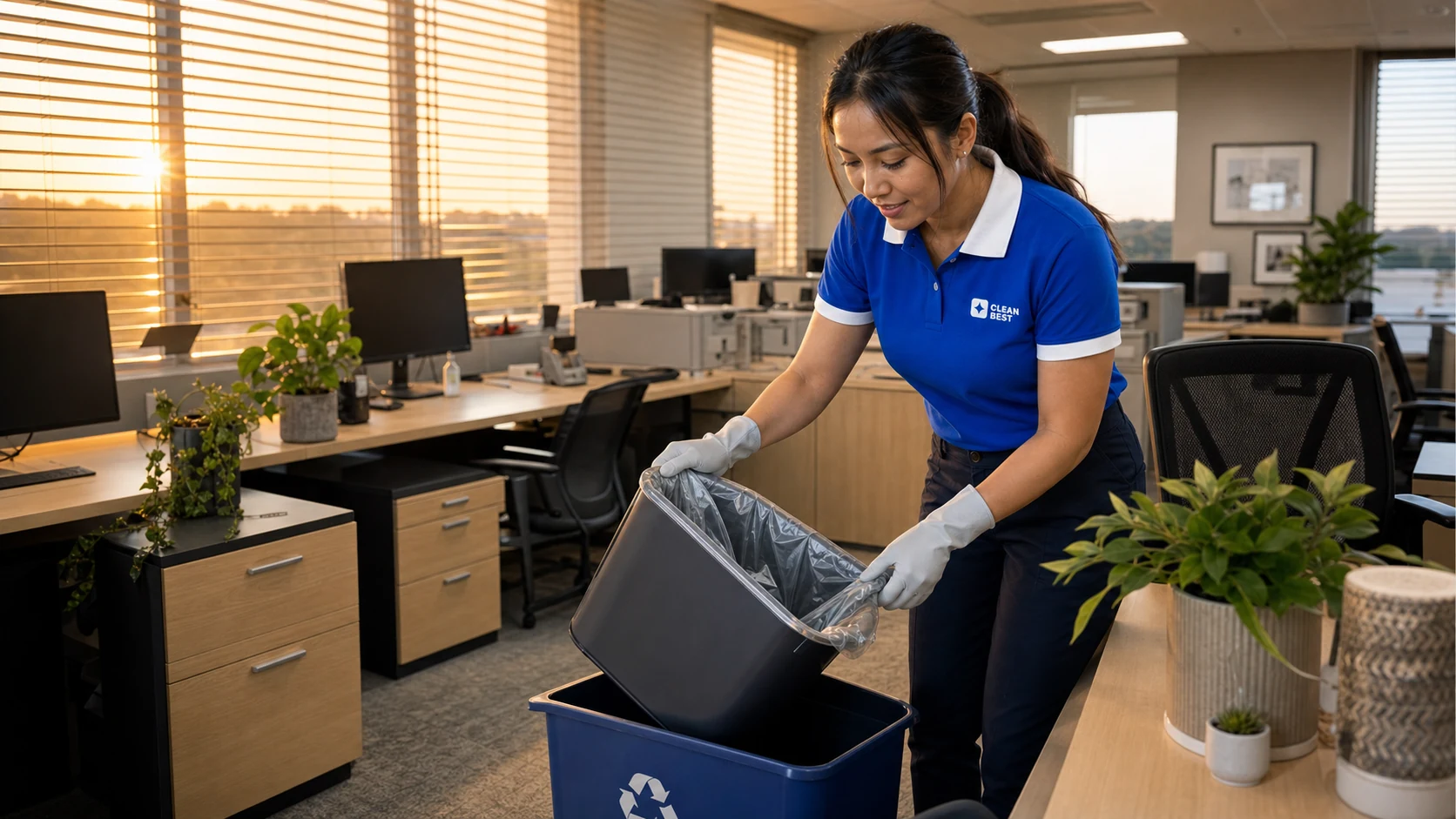
The boundary with production

Production and food handling areas are almost always outside a general office cleaning arrangement, cleaned instead by the operation's own staff or by a specialist contractor working to documented procedures and materials. The office schedule should say so explicitly rather than leaving a boundary that somebody might reasonably assume falls elsewhere, because an assumption in this area is expensive to correct.

The boundary also governs movement and equipment across the premises. Which doors a cleaner may pass through, what may be carried between areas, whether colour-coded equipment applies and where materials may be stored are all questions the operation will have a firm view on. Settling them during mobilisation is considerably better than discovering a problem during an audit or an inspection visit.

Pest management and waste timing

In any food-related premises, waste timing matters more than in an ordinary office. Waste that sits overnight in a warm area, or bins that are not properly closed, create conditions that the operation's pest management arrangements are designed to prevent. The schedule should state when waste leaves the premises and where it goes, in terms specific enough to be followed.

This applies to the office as much as to the operation. A staff room bin containing food waste is the same problem whichever part of the building it sits in. Treating waste removal from all areas as a fixed daily item, regardless of what other frequencies apply, is usually the simplest way to keep the arrangement consistent with the site's wider requirements.

Fixed and flexible items at a Smithfield food business office

  • Staff room, amenities and change areas identified as fixed daily items
  • Waste removal from all areas held daily regardless of other frequencies
  • Administration office assessed on ordinary commercial grounds
  • Production and food handling areas explicitly outside the office scope
  • Movement, equipment and storage rules confirmed with the operation
  • Bin closure and waste route stated in terms a cleaner can follow
Clean Best supervisor checking office presentation quality in Norwest NSW

Working in Smithfield and the Western Sydney

Smithfield in Western Sydney holds industrial estates, food production, warehousing and trade premises, and the offices attached to food businesses sit alongside amenities and staff facilities governed by the operation's own hygiene arrangements. The administration area itself is usually an ordinary commercial space. Clean Best services Smithfield from Seven Hills and separates the fixed items from the flexible ones in the schedule, because treating an entire premises as non-negotiable makes the arrangement more expensive than it needs to be without improving anything that matters.

Questions about Smithfield

Are production areas ever included in an office schedule?

Very rarely, and it is better that they are not. Those areas are subject to documented procedures, specific materials and often specialist equipment, and they are usually handled by the operation's own staff or a specialist contractor. The office schedule should state the boundary explicitly so nobody assumes coverage that was never agreed.

Which office items should stay daily?

Waste from every area, the staff room and its kitchen, amenities used by production staff, and change areas. Those are the items where the operation's wider requirements reach into the office side of the premises. Desk areas, meeting rooms and general circulation can be assessed on the same basis as any commercial office.

Does the cleaner need specific training for a food site?

Site induction is usually required and may include specific instructions about movement, equipment and storage within the premises. The requirements are set by the operation rather than by the contractor, and they should be established during mobilisation rather than on the first attendance. Where colour-coded equipment or restricted routes apply, those belong explicitly in the written schedule.

How should office waste be handled?

Removed daily, with bins closed and taken to the designated point rather than left in a corridor or beside a full store. In a food-related premises the timing and route matter more than in an ordinary office because of the site's pest management arrangements. The schedule should state both specifically enough to be followed by a relief cleaner.

Can the administration office run at a lower frequency?

Often yes, provided waste stays daily and the staff areas are held at their fixed standard. Desks, meeting rooms and general circulation in an administration office carry no particular requirement beyond the ordinary, so the usual considerations of occupancy and visibility apply to them. Separating those from the fixed items is exactly what makes a sensible reduction possible.

Get a fixed written quote for Smithfield

Free walkthrough, scope in writing, price back within 24 hours.

Request a quote
Call nowEmail us